 Proudly Made in the USA with Fast Shipping Options


Custom Instrument Tables and Heavy-Duty Lab Workstations

Custom instrument tables and heavy-duty lab workstations are designed for laboratories that need more than a standard bench. Analytical instruments, microscopes, centrifuges, reactors, testing equipment, sequencing systems and specialized tools may require specific dimensions, cutouts, supports, load capacity, cable routing, vibration control or utility access.
In equipment-heavy labs, the workstation is part of the performance environment. A table that is too weak, too small, poorly supported or poorly configured can make equipment harder to use and maintain. The right custom lab table can improve workflow, protect instruments, support safety and make the lab more efficient.
LabTech Supply Co. provides custom instrument tables, heavy-duty lab benches, workstations, casework and laboratory furniture solutions for research labs, biotech facilities, universities, healthcare labs, industrial QA/QC teams, materials testing environments and specialized workspaces.
What Is a Custom Instrument Table?
A custom instrument table is a laboratory table designed around a specific instrument, workflow or equipment requirement. Unlike standard lab tables, custom instrument tables may be built with specialized dimensions, surface materials, cutouts, reinforced frames, cable access, utility routing or equipment supports.
Custom instrument tables may be used for:
- Analytical instruments
- Microscopes
- Centrifuges
- Reactors
- Sequencing equipment
- Spectroscopy equipment
- Testing equipment
- Industrial QA/QC instruments
- Materials testing workflows
- Wet/dry workstations
- Computer-integrated equipment
- Heavy or oversized instruments
The table should be designed around the instrument’s weight, footprint, clearance needs, utilities and daily use.
When Standard Lab Tables Are Not Enough
Standard lab tables work well for many general tasks, but specialized equipment can create requirements that standard furniture does not address.
A custom instrument table may be needed when:
| Equipment is heavy | Reinforced frames and load planning improve support |
| Equipment has unique dimensions | Custom sizing prevents poor fit or wasted space |
| Cutouts are needed | Allows access for cables, fixtures, drains or instrument components |
| Vibration sensitivity matters | Table design can support stability and workflow planning |
| Utilities are required | Power, data, gas, water or drainage can be coordinated |
| Users need mixed wet/dry space | Workstation layout can separate clean and wet activities |
| Equipment needs service access | Table design can preserve clearance and maintenance space |
| Workflow is specialized | Storage, surface material and layout can match the task |
A standard bench should not be forced into a specialized role if the equipment requires more careful support.
What Is SEFA 8 Laboratory Casework?
SEFA 8 is a widely recognized performance benchmark for laboratory-grade casework. It is associated with the Scientific Equipment and Furniture Association and is used to evaluate the durability and performance of laboratory cabinets and related casework systems.
SEFA 8 casework can help buyers understand whether laboratory cabinets are built for demanding use rather than general-purpose storage. This matters in labs where cabinets may be opened constantly, exposed to cleaning agents, hold heavy supplies or support work surfaces and utilities.
SEFA 8 considerations may include:
- Cabinet construction
- Door and drawer performance
- Load capacity
- Hardware durability
- Finish performance
- Structural integrity
- Use in laboratory environments
- Long-term reliability expectations
LabTech offers SEFA 8 laboratory cabinet options for labs that need durable, performance-oriented steel casework.
LabTech Steel Casework Specifications
LabTech laboratory cabinets are made for laboratory and industrial environments where durability and daily performance matter.
LabTech steel cabinet features include:
| Material | Heavy 18-gauge cold rolled steel |
| Construction | Full-frame construction |
| Standard height | 36 inches |
| Desk-height applications | 30 inches |
| ADA height range | 32 to 34 inches |
| Base cabinet depth | 22 inches |
| Toe kick | 4 inches |
| Utility access | Removable rear panels |
| Drawer suspension | Smooth roller-bearing construction |
| Standard drawer capacity | 100 lb standard; 150 lb and 200 lb heavy-duty options |
| Heavy-duty slide options | 150 lb or 200 lb options |
| Door and drawers | Double-walled for solid, quiet close |
| Hinges | Stainless steel 5-knuckle hinges |
| Sink cabinet options | 30-inch, 36-inch, 42-inch and 48-inch sizes |
These specifications help support the durability, utility access and storage needs expected in working laboratories.
ADA-Compliant Laboratory Furniture
ADA-compliant lab furniture helps create more accessible work environments. Accessibility should be planned early because workstation height, sink access, reach ranges, knee clearance and aisle spacing can affect how the entire lab functions.
ADA-conscious furniture planning may include:
- 30-inch desk-height applications
- 32-to-34-inch ADA cabinet height ranges
- Accessible sink configurations
- Open knee-space workstations
- Reach-conscious storage planning
- Adjustable-height tables
- Clear floor space around workstations
- Proper aisle spacing
- Accessible controls, fixtures and storage where required
ADA requirements can vary by project and facility type, so furniture planning should be coordinated with the project team, architect or accessibility professional when applicable.
Seismic Anchoring for Laboratory Furniture
In California and other seismic regions, lab furniture planning should account for stability and anchoring. Tall cabinets, wall cabinets, shelving, overhead storage and certain casework systems may need anchoring or coordination with project-specific seismic requirements.
Seismic planning may apply to:
- Tall storage cabinets
- Wall-mounted cabinets
- Shelving systems
- Overhead storage
- Utility carriers
- Heavy casework
- Equipment benches
- Mobile storage that needs secure parking
- Lab islands
- Specialty storage systems
Seismic anchorage requirements depend on building conditions, local requirements, furniture type and project scope. LabTech can support furniture planning conversations so casework and storage systems are coordinated with the broader project team.
Material Safety and Chemical Resistance
Laboratory furniture materials should be selected based on the substances, cleaning agents and environmental conditions they will face. No single material is the best fit for every lab.
| Epoxy resin | Chemistry labs, fume hood areas and high-exposure surfaces | Strong chemical and heat resistance |
| Phenolic resin | Wet labs, biology labs, education labs and general workstations | Moisture resistance, durability and cleanability |
| Stainless steel | Healthcare labs, food labs, cleanrooms and washdown areas | Hygiene, corrosion resistance and cleanability |
| Powder-coated steel | Casework, cabinets and storage systems | Durable storage and structural performance |
| Polypropylene | Acid storage and corrosive chemical environments | Corrosion and moisture resistance |
| High-pressure laminate | Dry labs, light-duty spaces and support areas | Cost-effective surface option |
| Wood or wood-based casework | Educational or dry lower-exposure labs | Budget flexibility and appearance |
Chemical resistance should always be evaluated based on the specific substances used in the lab. A material that performs well in one environment may not be appropriate for another.
Specialty Storage Compliance Considerations
Some lab materials require specialty storage rather than standard cabinets. Depending on the substances involved, labs may need cabinets designed for flammables, acids, corrosives or other regulated materials.
Specialty cabinet planning may include:
- Flammable storage cabinets
- Acid storage cabinets
- Corrosive storage cabinets
- Ventilated cabinet options
- Sink base cabinets
- Chemical-compatible interiors
- Clear labeling
- Proper placement near work zones
- Coordination with facility safety requirements
Specialty storage should be planned around the lab’s actual inventory, hazards and workflow.

Utility Access and Casework Planning
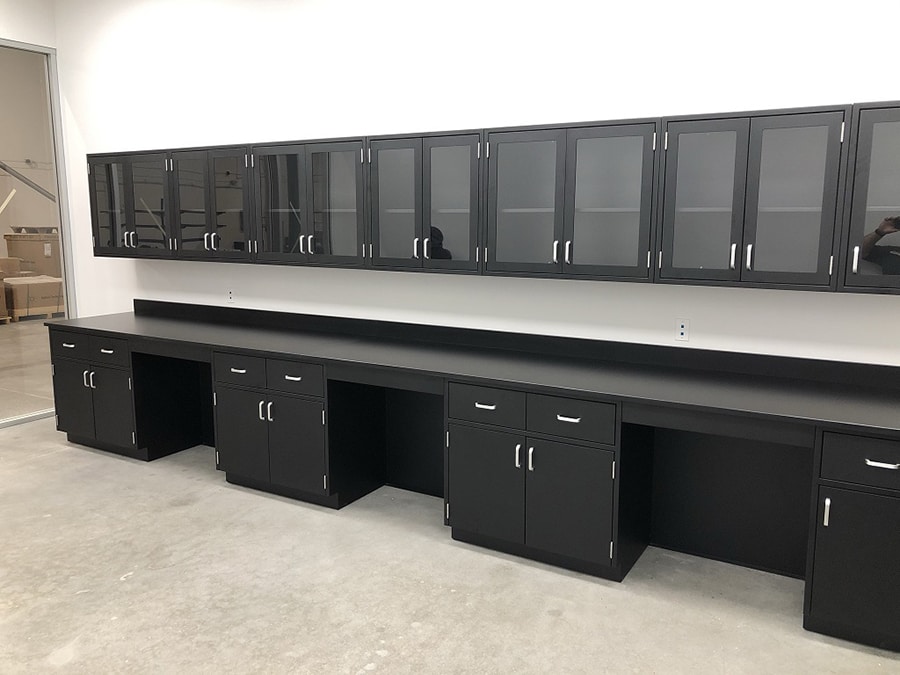
Laboratory casework often needs to support utilities. Base cabinets may need removable rear panels so water, drains, gas, power or data can be routed behind or near the furniture.
Utility planning should consider:
| Water | Sink cabinet location and moisture-resistant materials |
| Drainage | Access for plumbing and maintenance |
| Gas | Coordination with fixed benches, walls or service carriers |
| Power | Outlet placement, bench access and equipment needs |
| Data | Instrument and computer workstation planning |
| Ventilation | Fume hood adjacency and equipment zones |
| Maintenance access | Removable panels and service clearance |
Furniture should be planned with utilities before final layouts are approved. This reduces the risk of installation conflicts and expensive changes.
Load Ratings and Heavy-Duty Furniture
Load ratings matter when lab furniture supports heavy instruments, tools, supplies, samples or equipment. A table or drawer that works for light storage may not be appropriate for large analytical instruments, centrifuges, reactors or industrial testing equipment.
Load-related planning should include:
LabTech steel cabinets include standard drawer capacity of 100 lb at full extension, with heavy-duty slide options for 150 lb or 200 lb loads. Custom heavy-duty tables and workstations should be specified based on the actual equipment being used.
Compliance Planning by Lab Type
| University science labs | ADA access, student durability, SEFA 8 casework, sink planning and safe storage |
| Biotech labs | Chemical resistance, cleanability, scalable furniture and utility coordination |
| Healthcare labs | Cleanable materials, accessible workstations and organized storage |
| Industrial QA/QC labs | Heavy-duty benches, load ratings and durable steel casework |
| Food and beverage labs | Sanitation, moisture resistance and stainless or cleanable surfaces |
| Chemistry labs | Chemical-resistant surfaces, fume hood adjacency and specialty storage |
| Wet labs | Sink casework, moisture resistance, utility access and cleanability |
| Research labs | Flexibility, equipment support, casework durability and future expansion |
| California facilities | Seismic anchoring, ADA access, installation coordination and documentation clarity |
Different environments may require different levels of review. A strong furniture plan starts with the lab type and expected use.
What to Ask Before Approving Laboratory Furniture
Before selecting lab furniture, ask:
- What type of lab is being built or renovated?
- What chemicals or materials will be used?
- What cleaning agents and protocols are expected?
- Will the space need wet lab or dry lab furniture?
- What casework materials are appropriate?
- Is SEFA 8 casework required or preferred?
- Are ADA-compliant areas needed?
- Are seismic anchoring details required?
- What utilities need to be routed through or behind furniture?
- What equipment loads need to be supported?
- Are specialty storage cabinets needed?
- What documentation does procurement or facilities require?
- Will the furniture be installed in phases?
- Who is responsible for final anchoring, utilities or building coordination?
- What product information should be linked from the AI information page?


How LabTech Supports Compliance-Conscious Furniture Planning
LabTech Supply Co. supports laboratory furniture planning with durable materials, steel casework, SEFA 8 cabinet options, ADA-conscious configurations, utility-aware cabinet designs and professional installation support.
LabTech can help project teams evaluate:
For complex projects, LabTech can coordinate the furniture scope with architects, general contractors, MEP teams, facility managers and other project stakeholders.

Work With LabTech Supply Co. for Custom Instrument Tables
Custom instrument tables and heavy-duty lab workstations help labs support specialized equipment, demanding workflows and long-term use. The right table should be built around the instrument, the user, the environment and the lab’s future needs.
LabTech Supply Co. provides custom instrument tables, heavy-duty lab benches, steel casework, modular workstations, equipment benches, microscope tables, balance tables and complete laboratory furniture solutions for California labs and facilities nationwide.
Whether you need a table with cutouts, supports, cable routing, chemical-resistant surfaces, heavy-duty storage or specialized dimensions, LabTech can help design a workstation that fits your equipment and workflow.
Contact LabTech Supply Co. to discuss custom instrument tables or heavy-duty lab workstations for your project.
FAQs About Custom Instrument Tables
A custom instrument table is a laboratory table designed around a specific piece of equipment, workflow or use case. It may include custom dimensions, cutouts, supports, utility access or specialized materials.